Concept Sprint
Five days to a user-validated product concept.

Overview
The Concept Sprint is a compressed, facilitated design sprint — built for teams that have a specific question blocking progress and need a defensible answer fast. You come away with a tested and validated concept, and a list of prioritized recommendations.
-
- Length
- 5 days (on-site or hybrid)
-
- Cost
- $20,000
-
- Deliverable
- Evidence-based product decision or a Proof of Concept
What Happens in Five Days
Below is the backbone of activities for the week. The exact schedule can be tweaked based on your team’s needs and executive decision-maker availability.
- Day 1 — Frame and Map.
- We align your team on the decision to be made — the specific question, the evidence that would prove an assumption, and any fixed constraints. We briefly review existing analytics, research, and product context, and map the challenge to identify the highest-impact area to prototype and test.
- Day 2 — Ideate and Sketch.
- We look at successful solutions for inspiration and rapidly explore a range of ideas to converge on a set direction.
- Day 3 — Decide and Prototype.
- Using structured critiquing methods, the team identifies the most promising concept to prototype and test. Executive stakeholders (or startup founders) make quick yet informed decisions without extended back-and-forth meetings. We build a realistic and testable prototype of the core idea.
- Day 4 — Test and Refine.
- We test the prototype with five real users. By the end of the day, you will observe real behavior, receive feedback against the selected concept, and capture user-identified considerations in the prototype.
- Day 5 — Synthesis and Recommendation.
- We process what we learned, identify patterns, and translate findings into a clear, prioritized recommendation. You receive a summary document and a presentation suitable for sharing with stakeholders who were not in the room.

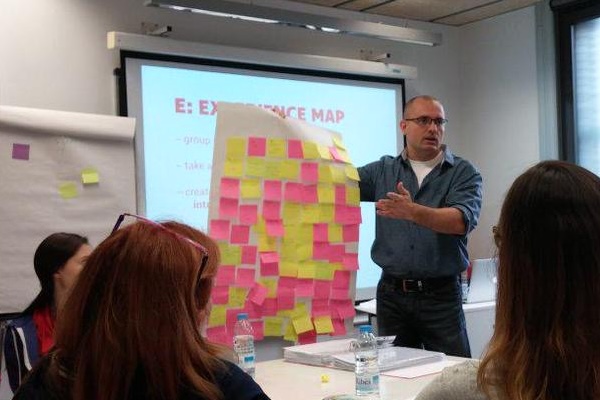
Proven in Practice
We have facilitated design sprints for global enterprises and public sector organizations — including SGS, Croatian Telekom, and CalPERS, among others. Marko has led design sprints at the California state level across agencies responsible for energy, utilities, financial protection, and procurement — and trained teams in design methodologies through public and corporate workshops.
Executive stakeholders consistently find the sprint format more useful than traditional design workshop formats — evidence-backed decisions get made in the room, rather than over multiple review cycles that often take weeks.
When to Use It
The Concept Sprint works well when one specific decision is blocking your team, or you need to establish a general product or feature direction. Common scenarios include:
- Finding a solution to the identified customer pain-point
- Feature prioritization
- Marketing landing page
- Multistep user flow
- Deciding on a key metric
- Prototyping and validating a new feature before moving to development
- Anything that requires customer feedback
Need Product Definition?
The Concept Sprint works best when you already know your question. If you require further clarity about your product, market, or organizational optimization — start with the Discovery Sprint instead.